Stop buying software. Start buying decisions. Aluvial gives product, feedstock, and investment teams go/no-go answers on performance, placement, and commercial viability in weeks — not seasons.
The models are calibrated against real production environments. The outputs are built for the decision in front of you, not averaged across conditions that don't apply to your commercial case.
Placement decisions that need to hold up under scrutiny.
Biological & Biostimulant Developers
Seed & Trait Innovators
SAF Feedstock Aggregators
Private Equity & Ag Asset Managers
SEQ 03 // THE SOLUTION
Aluvial — the Ag Decision Engine.
Aluvial is built around one question most agricultural trials fail to answer: where does this product work, for which genetics, and under what conditions?
That answer requires resolving three interacting dimensions across real production systems, not averaging them away.
Products
Responder classifications
Places
Placement maps
Decisions
Go/no-go recommendations
Decision framework
G × E × M
G
Genetics
What you plant
What you plant determines how a product performs. A fungicide applied to a susceptible versus a tolerant variety can produce a 15–25 bu/ac yield response difference in wheat — same product, same environment, genotype drives the outcome.
E
Environment
Where and when it grows
Soil water capacity, temperature, and nitrogen availability interact with genotype and management in ways that averages obscure and only conditional modeling reveals.
M
Management
How it is grown
Application timing, nitrogen rate, termination window, and tillage practice modify both the product signal and the environmental response.
Aluvial resolves the G×E×M interaction at field scale — producing responder classifications, placement maps, and go/no-go recommendations grounded in how crops actually behave across real production systems.
Operating scale
One engine. Two operating scales.
Aluvial accelerates client R&D work by leveraging AI inference and biophysical modeling at the 'micro' scale and the 'macro' scale. Micro focuses on product-level response questions. Macro focuses on system-level placement and management questions.
Micro
G × E
Genetics by environment
Which genetics respond, where the signal holds, and when environment changes the answer. This is the product question.
Macro
E × M
Environment by management
How place, timing, practices, and constraints shape performance across production regions. This is the placement question.
Bio-industrial value chain
Uncertainty is most expensive at the decision point.
Three segments. Different questions. The same need for a confident answer before capital moves.
Biological Inputs
Which products perform, where, and under what conditions.
Trial simulation and site selection before field investment.
Value-based placement by geography and responder class.
Seeds and Genetics
Hybrid placement by field and management system.
Multi-year trial simulation and advancement pipeline analysis.
Genotype-conditional response surfaces for licensing and commercialization decisions.
Renewable Fuels
Where to source and contract feedstocks.
Carbon intensity scoring under 45Z, CORSIA, and EU RED III.
Long-term yield contract viability by geography and stress-year scenario.
What Aluvial is not
Not another dashboard wearing an AI label.
Not a visualization layer
Maps and charts are delivery surfaces, not the product. The product is the bounded prediction behind the decision.
Not agronomic text generation
Aluvial doesn't ask a language model to pattern-match toward plausible advice. The output is a bounded prediction with a confidence interval, not a recommendation that sounds right.
Not historical averages
The engine simulates crop behavior under genetics, environment, and management constraints — then returns uncertainty when the evidence isn't strong enough to decide.
Why this matters now
The wrong average can become a launch, procurement, or underwriting problem.
Fast No
Sometimes the most valuable answer is no.
If the evidence does not support a confident go recommendation, Aluvial says that early. A Fast No protects field budgets, channel relationships, and launch timing before a weak signal gets scaled.
45Z / CORSIA / RED III
CI claims are moving into contract windows.
45Z applies to fuel produced after December 31, 2024. CORSIA enters its first phase. RED III transport targets are moving into EU implementation. Feedstock programs that contract now without field-level CI intelligence risk locking supply sheds that won't clear.
P10 / P50 / P90
The downside number is often the decision number.
P50 is the median outcome. P10 is the stress-year view. For launch, contracting, and compliance decisions, the P10 often determines whether the program still works when conditions turn against it.
PE and asset managers
Turn yield assumptions into underwriting evidence.
Single-point yield assumptions don't stress-test a deal. Aluvial converts agronomic variance into P10/P50/P90 exposure by geography — so investment teams can defend portfolio risk, CI exposure, and asset fit.
Customer-specific precision
The Compounding Advantage
Every engagement makes the models more precise — compounding across your geographies, your genetics, your management systems.
When your proprietary trial data and operational knowledge are integrated with Aluvial's continental-scale foundation models, the result is a customer-specific model no competitor can replicate. Your data reflects conditions and decisions only you have accumulated. Combined with Aluvial's biophysical priors, predictions sharpen beyond what either source produces alone.
Your data stays yours
Client data is isolated by engagement — never used to train shared models or inform outputs for other clients.
Precision compounds
First engagement
Predictions carry wider confidence intervals.
Third engagement
Predictions over the same geography are materially more precise.
Calibration basis
Model updates are calibrated against your actual data, not regional averages.
How an engagement works
1
Define
Scope the decision worth winning — geographies, products, success criteria. We define what a go/no-go answer looks like before any modeling begins.
2
Execute
Aluvial scientists work directly with your team, combining our foundation models with your proprietary data to iterate against the actual commercial decision.
3
Deploy
Results land where decisions get made — through the Aluvial interface, API, or MCP integration into your existing workflows.
SEQ 06 // SEE IT IN ACTION
ALUVIAL FRAME — visualize your biophysical advantage
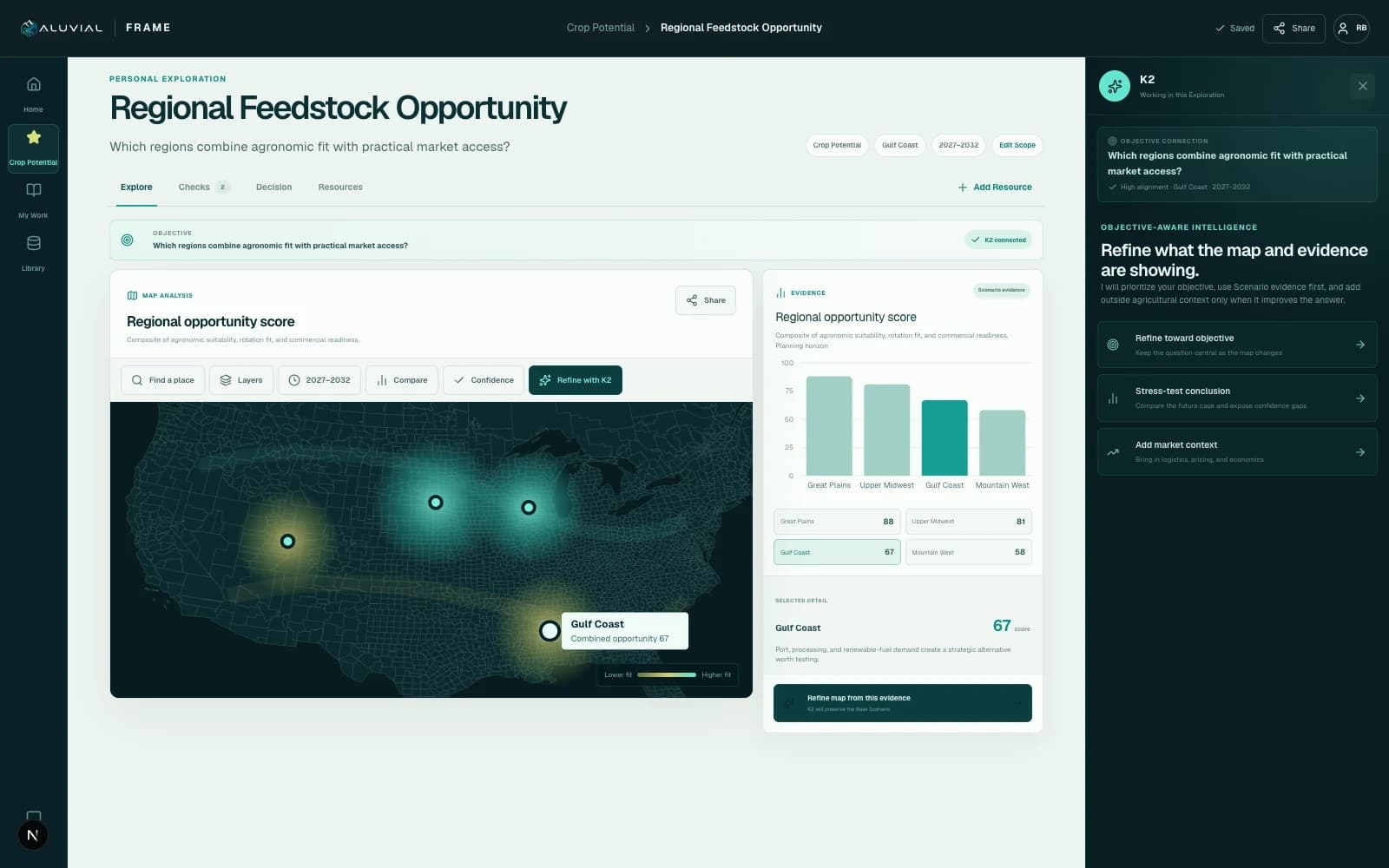
Frame is the client entry point for Aluvial's AI work: a place to inspect modeled evidence, run scenario questions, and turn outputs into shareable commercial recommendations. It gives teams a common operating surface before results move into API, MCP, or internal reporting workflows.
Aluvial Frame
Biophysical intelligence for agriculture
≡
9
Notebook turns
Exploration
Active section
0
Knowledge sources
Number of Foundation Model Records
Biophysical
422K
● Corn
Share of total 100.0%
Training records 422,025
Yield by Year
Corn
2022
2023
2024
2025
2026
018.236.454.6
Notebook cells
Streaming reasoning over maps, charts, and BMST endpoints
Live section
Cell 01
5/25/2026 — Exploration
Where does corn yield risk change after we account for rotation frequency?
YieldRotationCounty map
Frame linked the regional yield footprint to the active rotation layer for corn in North America.The strongest placement signal stays clustered where repeated corn frequency and modeled yield stability agree.Counties outside the stable band are marked for BMST point-scale review before a recommendation moves forward.
Cell 02
5/25/2026 — Foundation model results
How much training evidence is behind the selected crop model?
BiophysicalCorn422,025 records
The selected corn model is backed by 422,025 foundation-model records.Yield by year shows a wide stress-year tail, so the decision should use distributional risk rather than a single average.Seasonal date checks align planting, harvest, and season length before the BMST target is queued.
Cell 03
5/25/2026 — BMST
Which geographies should move from map review into BMST simulation?
Targeting mapJob statusCompleted 1425
The county-level BMST targeting map shades counties by the active agronomic metric and flags candidate run points.Shared run history has 1,425 completed jobs available for comparison.The selected high-yield run returns 250.0 bu/ac and can be reopened for detail review.
Cell 01
5/25/2026 — Exploration
Where does corn yield risk change after we account for rotation frequency?
YieldRotationCounty map
Frame linked the regional yield footprint to the active rotation layer for corn in North America.The strongest placement signal stays clustered where repeated corn frequency and modeled yield stability agree.Counties outside the stable band are marked for BMST point-scale review before a recommendation moves forward.
Cell 02
5/25/2026 — Foundation model results
How much training evidence is behind the selected crop model?
BiophysicalCorn422,025 records
The selected corn model is backed by 422,025 foundation-model records.Yield by year shows a wide stress-year tail, so the decision should use distributional risk rather than a single average.Seasonal date checks align planting, harvest, and season length before the BMST target is queued.
Cell 03
5/25/2026 — BMST
Which geographies should move from map review into BMST simulation?
Targeting mapJob statusCompleted 1425
The county-level BMST targeting map shades counties by the active agronomic metric and flags candidate run points.Shared run history has 1,425 completed jobs available for comparison.The selected high-yield run returns 250.0 bu/ac and can be reopened for detail review.
What customers do here
01
Explore
Maps, charts, and reasoning over endpoints.
02
Simulate
Test products, practices, and geographies at scale.
03
Share
Share results that drive R&D and commercial decisions.
6. API & MCP Integration
Machine-readable decisions, delivered directly.
Hosted at alvl.io
For clients with internal data-science capacity, Aluvial delivers machine-readable outputs directly — via REST APIs and MCP servers hosted at alvl.io.
ACCESS // API
REST API
Pull trial placement, CI scoring, genotype-conditional simulations, and decision endpoints directly into data science pipelines and product workflows.
ACCESS // MCP
MCP Server
Connect via MCP and Aluvial's decision engine becomes a tool your own models can reason over on demand.
ACCESS // STRUCTURED OUTPUTS
Micro to Macro
Structured access covers both micro-trial simulation outputs and field-scale macro-trial synthesis.
Your systems. Our intelligence. No intermediary.
Decision outputs
What Aluvial makes
Four output families anchor Torrent engagements: performance, feedstock, diligence, and enterprise delivery. Each produces decision-ready evidence your team can use, extend, or connect into existing systems.
What you receive
Confidence bounds, risk profiles, and recommended actions
County-level CI and feedstock risk screen with downside ranges
Asset or portfolio scenario model with region-level exposure
Structured API, MCP, or interface delivery for internal workflows
Output
Performance Intelligence
Launch decisions improve when you can see responder classes, trial placement priorities, and downside conditions before broad field spend.
Output
CI & Feedstock Intelligence
Scoped
Feedstock programs need localized CI, yield, and contract risk views before acreage and procurement move forward.
Typical output
P10, P50, and P90 CI distributions under frameworks such as GREET and CORSIA.
County-level yield, oil content, and CI surfaces by stress scenario.
Output
Portfolio & Due-Diligence Intelligence
Scoped
Compare assets and regional strategies with modeled yield, risk, and CI exposure rather than single-point assumptions.
Typical output
P10/P50/P90 exposure by geography for agricultural assets and portfolios.
Cross-engagement benchmark patterns and genotype response profiles.
Output
Observational Data & MRV Infrastructure
Scoped
Some clients need direct exports and ongoing compliance infrastructure, not just a one-time memo.
Typical output
Pre-processed yield summaries and treatment-level aggregates.
MRV subscription tiers with Sentinel-1 and Sentinel-2 anomaly detection.
What you retain
An engagement should leave you with more than a report.
A first Torrent scope establishes the decision baseline your next scope builds from. Three engagements over 18 months should not produce three disconnected PDFs; they should produce a sharper model of your products, geographies, and decision thresholds.
Client-specific decision baseline
The starting model, assumptions, thresholds, and known uncertainty bands for your scope.
Structured outputs
Maps, confidence distributions, ranked geographies, and recommendation status your team can reuse.
Interface and access path
Aluvial Frame for human review, with API/MCP delivery when your internal systems need structured access.
Compounding reference point
Subsequent scopes compare against the prior baseline, narrowing uncertainty where evidence accumulates.
Where Torrent engagements focus
Choose the decision lane, then choose the depth.
Aluvial Torrent can start with a focused placement question or expand into a strategic system for feedstock, diligence, MRV, and machine-readable delivery.
Test
Validate a biological or genetics program
Biological Response Intelligence
Controlled response modeling identifies where a product works, who responds, and where a launch is likely to stall — before field budgets and channel relationships are committed.
The output is a defensible launch case with placement recommendations, not an average across environments.
Scale
Screen feedstock pathways before expansion
CI & Feedstock Intelligence
Model where yield, oil content, carbon intensity, and profitability clear together — before acreage, procurement, or compliance claims move into the market.
The result is a pathway screen that distinguishes where a program actually qualifies from where it only looks like it does on paper — and where a single stress year breaks the economics.
Prove
Underwrite a product, asset, or region
Portfolio & Due-Diligence Intelligence
Convert agronomic variance into investment-grade diligence — expected performance, downside exposure, and regional fit modeled before capital is committed.
The output can hold up in investment review, commercialization planning, or partner diligence.
Embed
Extend proven work into internal systems
MRV & Enterprise Infrastructure
Once the value is proven, some teams need to operationalize it — structured exports, MRV workflows, and machine-readable delivery built into their internal systems.
This is the path from a validated Torrent engagement to permanent infrastructure.
Outcomes, not hours
Every Torrent engagement is scoped around a named commercial decision, not billable field days or disconnected data exports.
Your data stays yours
Client data is isolated by engagement and never used to train shared models or inform outputs for other clients.
Decision-ready delivery
Outputs are built for product managers, BD leads, investment teams, and technical teams that need structured access.
SEQ 08 // THE PROCESS
The Aluvial Torrent — how we activate your advantage
01Goal
02Execute
03Deploy
Define the decision worth winning.
Customer commercial / R&D question
Define success criteria up front
Scope geographies, products, decisions
Our scientists work directly with your team.
Aluvial team + your team
Foundation models + your proprietary data
Iterate fast against the actual decision
Land it where decisions get made.
Aluvial Frame, API, or MCP integration
Plugs into your existing workflows
Repeat for the next decision with tighter confidence
A repeatable engagement model — scoped to the decision, delivered against it, built to compound.
Aluvial Torrent tiers
2 weeks
Foundation Onboard
Quick start
Goal
Understand customer objective
Execute
Onboard users to Frame + API for foundation models — foundation model data only
Deploy
12-month license
1 month
Foundation + 1 Customer Data
Add your data
Goal
Understand customer objective
Execute
Add one customer data variable; simulate over foundation models
Every decision Aluvial produces — from a single product placement to a multi-region portfolio — is built on models calibrated against field and greenhouse observations across major commodity and oilseed crops.
The physics constraints are not a claim about rigor. They are what make the confidence intervals meaningful — bounding predictions within what plant physiology and environmental forcing actually allow, so uncertainty estimates reflect the real sources of variance in the decision, not a sensitivity analysis applied after the fact.